
Compare Daviess County Property Value Types
Indiana assesses real property at full market value-in-use. That statutory target, set at 100 percent, is an assessment concept rather than a promise of what a parcel will fetch at sale. Daviess Engage splits each assessment into fields that only mean something when read with their year. Transfer evidence comes from a different record stream.
| Value type | What it means | Where it is recorded |
|---|---|---|
| Assessed value | Mass-appraisal value under market value-in-use | Daviess Assessor and Engage |
| Market value | An opinion of likely exchange value for a date and purpose | Qualified appraisal or market analysis |
| Last sale or consideration | A past transaction amount when disclosed and shown | Deed, sales disclosure, or parcel record |
| Land and improvements | Components that add to the assessed total | Engage parcel detail |
| Taxable value | Assessment after applicable deductions or exemptions | Assessment and tax records |
The 100 percent target does not merge these figures into one number. Market value-in-use follows Indiana assessment rules and annual adjustment. A recorded sale may be old, atypical, exempt from disclosure, or missing from a portal entirely, and a lawful deduction can lower taxable value without lowering the parcel's worth. Compare like fields only.
Read Daviess County Assessed Value Fields in Engage
The Daviess Engage search takes owner, address, or property number. A parcel detail card there shows plenty. Tax ID, situs and mailing addresses, owner, legal description, class, township, taxing district, school, valuation history, structures, land record, sketch, and photos all appear together on one screen. Note the land and improvement amounts separately. Add the total and the assessment year. Any displayed reason matters too. Copying the boldest number alone hides the pieces that make a Daviess County property value verifiable.
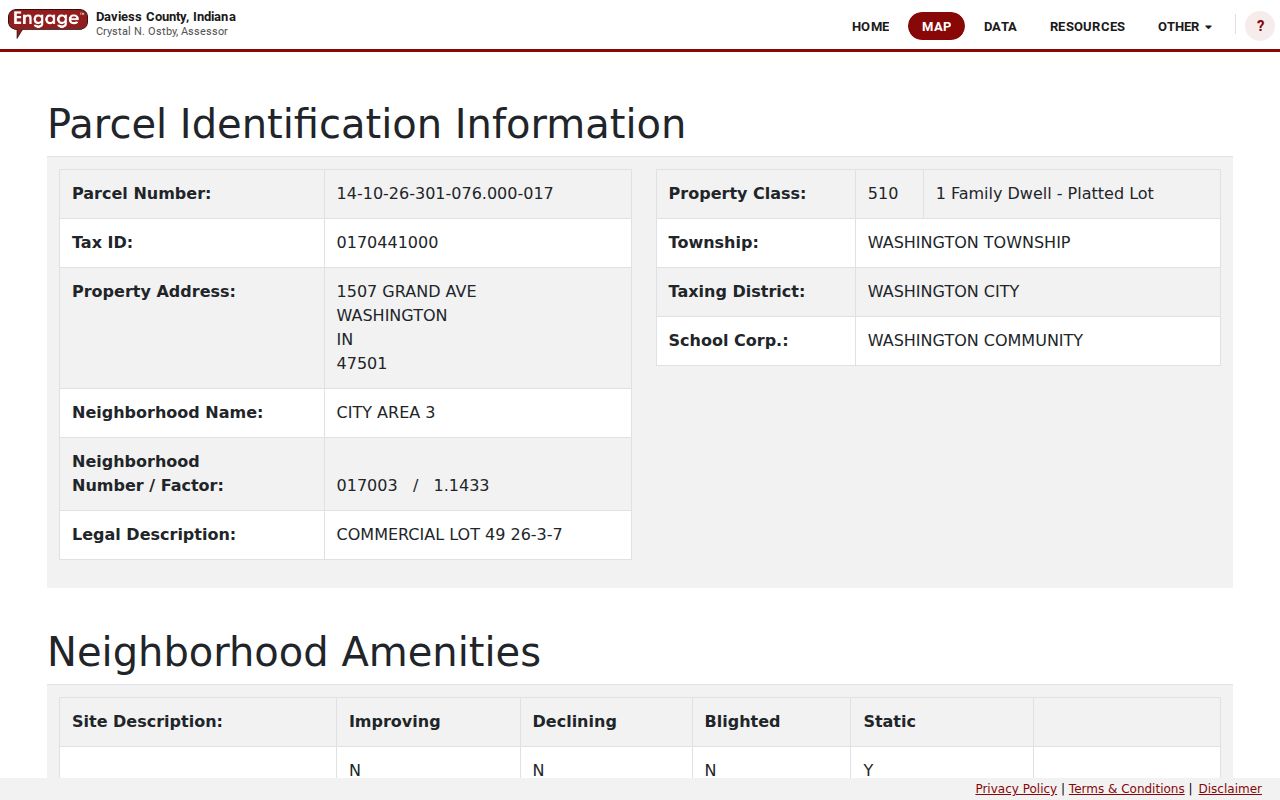
The same card listed no sales record. It also showed a transfer row dated 01/01/1900. Neither proves that no sale occurred, nor that a genuine deed was recorded on that placeholder date.
Note: Save the assessment year with every Daviess County property value, because figures from different years are never direct equivalents.
Annual Trending Changes Daviess County Property Values
Indiana has applied annual trending since 2002. Daviess resources list the inputs: prior sales, neighborhood conditions, local demand, economic conditions, and physical changes. A new value does not mean a deed transfer. The update may reflect the assessment process itself, a changed improvement record, or market evidence applied across a neighborhood. The DLGF cyclical reassessment page describes a statewide cycle that began July 1, 2026, covering the 2026 assessment payable in 2027. Roughly a quarter of parcels face physical inspection yearly. Note the reason for change. Record the inspection context too, before reading a year-to-year move as proof of a sale.
Estimate Daviess County Property Value From Official Fields
Official fields give a disciplined baseline. They do not forecast a sale price. Search the address, confirm the parcel by legal description and Tax ID, then read each value component beside its year. Compare recorded sale evidence only after checking its date and whether it covers the same tract.
- Search the address in Daviess Engage and confirm the Tax ID and legal description.
- Record land, improvement, total assessed value, assessment year, and reason for change.
- Check the Recorder or sales disclosure for a transfer amount only if that evidence is available.
- Compare dates, property class, neighborhood factors, and physical changes before interpreting a difference.
- Assessed value
- Indiana's mass-appraisal value for property-tax administration.
- Market value-in-use
- The state's standard tied to a property's current use.
- Assessment ratio
- The relationship between assessed and market value; Indiana targets 100 percent.
- Reassessment
- Review of property data and value within the statewide cycle.
Recorded Sales Are a Separate Daviess Value Clue
A deed can show consideration, and a sales disclosure can carry transaction data. Neither amount is guaranteed for every transfer. The Daviess County Recorder points searchers to Doxpop and keeps the instruments that affect real property. Doxpop reports county index and image coverage from January 1997. The Recorder page describes broader deed access from April 1957, including every deed index book.
Some transfers make poor comparisons. Think of deeds between relatives, estate sales, corrective instruments, or conveyances covering more than the subject parcel. Check deed type, parties, legal description, and date. A portal with no sale showing is missing evidence. It is not proof the land never changed hands.
Daviess County Taxable Value Is Not Assessed Value
Deductions and credits can shrink the taxable amount. They do not rewrite gross assessed value. Exemptions work the same way, trimming liability while the assessment of land and improvements stands. Keep gross assessment, deductions, taxable value, tax rate, and bill amount in separate columns. That habit prevents a lower bill from being misread. A cheaper bill does not mean the Assessor cut the property's market value-in-use. The detailed bill, payment status, and appeal route sit with the Daviess County property tax records process. For valuation analysis, identify which layer changed.
One Washington Card Shows Why Years Matter
One Washington parcel card rose from $159,500 in 2023 to $187,800 in 2026. That is a single history. It is not an average or forecast. Its real value is method. Keeping each assessment year, plus land, improvements, neighborhood factors, and change reasons, explains the difference instead of guessing at it. Do not extend that sample to a neighboring home. Nearby parcels can differ in class, acreage, structures, condition, use, and district, so a countywide conclusion needs a real group of comparable records rather than one card.
Check Daviess Property Values Online or With the Assessor
Engage moves quickly, yet other channels exist. The Daviess County Assessor sits at 300 E Hefron Street, Suite 231, in Washington. The office can walk you through assessment records. It can also point you to property-card resources. Engage Resources offers help with property cards, sales disclosures, annual adjustments, appeals, and map searches. A written request for an existing public record also works under Indiana APRA, IC 5-14-3. Ask for the record, not a fresh appraisal or a guess at value.
When you call or write, give the Tax ID. Include the property address. Add the owner of record if known, plus the assessment year. Request the existing card or the source field behind a figure. The county cautions that assessment data can change. So confirm anything with the office before relying on it.
What Daviess County Property Value Does Not Prove
The number has limits.
An assessed figure does not promise a sale price, fix a boundary, or establish title. It cannot describe every condition shaping a transaction. It remains a mass-appraisal record built for Indiana tax administration.
The date, the use, and the physical data all matter when reading it. So does the neighborhood model. A current parcel card can even sit beside an older sale record. It can just as easily rest against an incomplete portal history.
Value vs. price. A Daviess County assessed value is not a guaranteed sale price and is not a parcel-specific professional appraisal.